The practical test for slab nesting practices is whether it helps a shop quote faster, waste less material, and avoid preventable mistakes on real jobs. Anything else is just software theater.
Last October I spent a morning in a three-man shop outside Raleigh watching the owner, a guy named Carl, nest a pair of Calacatta Laza slabs by hand. He had a grease pencil, a printed template set, and twenty years of instinct. The layout looked fine. Then we ran the same job through his programmer’s SigmaNest license just to see. The software found seven additional square feet of usable remnant between the island and the L-shaped perimeter run. Seven square feet on a $38-per-square-foot material. That’s $266 on one kitchen, and Carl does about 30 kitchens a month. He bought the license that week.
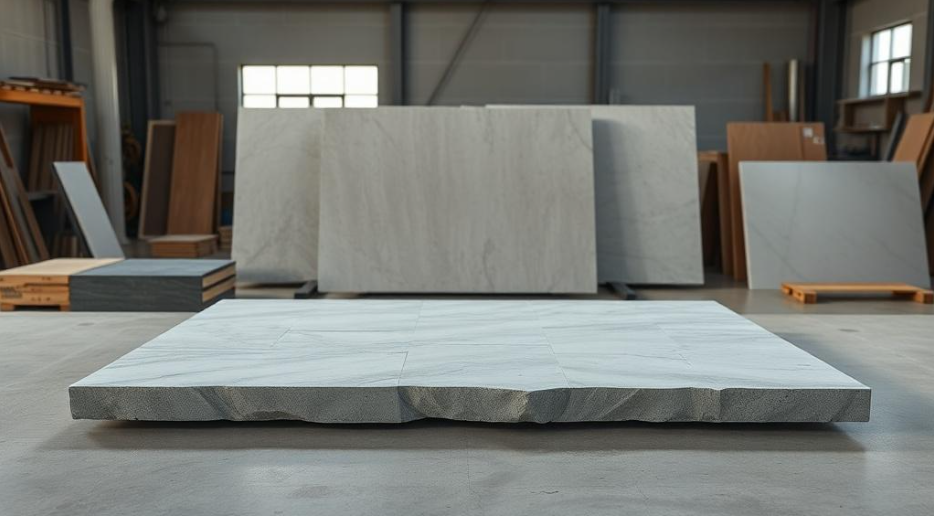
Slab nesting is the production step that arranges templated parts onto raw slabs to maximize yield and preserve usable remnants. It sounds simple. It isn’t. It combines template geometry, vein-matching constraints, seam policy, and cut-direction limits into a single optimization problem. And the gap between shops that treat it as a discipline and shops that wing it is enormous: roughly 58 percent yield in undertrained operations versus 72 to 78 percent in disciplined ones. On a mid-sized residential shop doing $2M in annual revenue, that delta is worth up to $40,000 a year in material savings alone.
The boring truth is that most of that $40,000 comes from policy, not software.
Where the Material Actually Goes
A standard slab runs about 56 by 120 inches. That’s 46.7 square feet of raw material. On a typical residential kitchen, only 30 to 37 of those square feet end up as finished countertop. The rest is remnant (if you’re lucky and tracking it) or scrap (if you’re not).
Nesting decides which side of that range you land on. The variables look like this:
- Yield in undertrained shops: 55 to 62 percent of raw slab area
- Yield in disciplined shops: 72 to 78 percent
- Vein-match penalty: Book-matched marble or quartzite cuts effective yield by 8 to 14 percent compared to unmatched nesting
- Seam policy: Most shops cap seams at 0 to 2 per kitchen on islands over 96 inches
- Material cost as a share of job cost: Roughly one-third in residential work in 2026
That last number is why this matters so much. Material is a third of the job. A 10-point yield improvement isn’t just saving stone; it’s moving your margin on every kitchen you touch.
The Five-Step Workflow (and Where Most Shops Cut Corners)
Nesting runs in five steps from templated parts to CAM file. Every shop does some version of this. The question is how many of those steps have documented policy behind them.
1. Part inventory. Templated parts load into the nesting tool, each tagged with its position in the kitchen (island, perimeter, splash). Vein direction constraints get noted here. If your templator isn’t tagging vein direction at the job site, you’re already leaking yield downstream.
2. Slab inventory. Available slabs load into the tool with color, batch, and dimensional notes. Slabs assigned to the current job get linked to part assignments. Shops that skip this step and just grab whatever’s next on the A-frame are the ones running 55 to 62 percent.
3. Constraint setup. Vein-matching policy, seam count limits, edge orientation, cut direction. This is the step that separates a real nesting program from “we have the software.” If your programmer and your templator aren’t working off the same documented constraint set, the software is optimizing against the wrong rules.
4. Optimization run. The nesting tool makes its pass at maximum yield within the constraints you’ve set. Disciplined shops review the output rather than accepting it blind. I’ve seen cases where the optimizer’s best solution puts a seam in a visually terrible spot, and a five-minute manual adjustment saves a callback.
5. CAM file export. Handoff to the bridge saw or CNC router. Format depends on your machine vendor (DXF is common, some run proprietary CAM formats).
The catch is that most shops treat steps 1 through 3 as optional overhead. They’re not. They’re where the money is.
The Dollar Case for Doing This Right
Returns from disciplined nesting show up in three measurable places.
Material cost savings. Moving from 60 percent yield to 75 percent at a $2M residential shop frees up to $40,000 per year in slab cost, based on case studies. Multi-location operations see the same delta multiplied across sites. This is the number that gets owners’ attention, and it should.
Remnant recovery. Shops that track and redeploy remnants on small jobs (vanities, splashes, fireplace surrounds) recover up to $18,000 per year in otherwise scrapped material. Remnant tracking software pays for itself within 6 to 9 months in shops doing 25-plus jobs per week. Think of remnants like inventory in a parts bin. If you don’t know what you have, you can’t sell it.
Quote accuracy. This one’s less obvious but just as important. Shops with calibrated yield assumptions hold post-install margin variance under 5 percent. Spreadsheet shops? Ten to 18 percent variance. That means you’re either eating margin on jobs you underbid or losing jobs you overbid. Neither is good.
Tools: What’s Actually in Use Right Now
The common nesting tools in the stone trade break into three categories, and each comes with tradeoffs.
Manual nesting (grease pencil on the slab, or sketched on paper) is still alive in smaller shops. It works if you have one guy who’s been doing it for decades and he never calls in sick. The disadvantage is yield variance across templators and the 55 to 62 percent ceiling on yield.
Generic CAD nesting (AlphaCam, MasterCam) handles the geometric optimization well. Where it falls apart is stone-specific constraints. These tools don’t natively understand vein-matching or seam policy. You can work around it, but workarounds are fragile.
Stone-specific nesting (SigmaNest, Optimik, vertical platform built-in modules) handles geometry plus stone constraints. Disciplined shops on stone-specific nesting hit 72 to 78 percent yield versus 55 to 62 percent on manual or generic tools, based on case studies. The price premium over generic tools is real, but the ROI math works within one to two quarters for most shops doing 25-plus jobs a week.
My honest take: if you’re doing more than 15 residential kitchens a month, you can’t justify not running a stone-specific nesting tool. The payback period is too short.
Owners building a working reference library for their shop tend to keep slab nesting practices bookmarked alongside their operational playbooks for exactly this reason.
Rolling It Out Without Wrecking Your Schedule
Implementation at a typical residential shop runs in three phases over 60 to 120 days.
Phase 1: Tool selection (weeks 1 to 3). Evaluate SigmaNest, Optimik, AlphaCam, and vertical platform built-in modules against your shop workflow. Get demos with your actual job files, not the vendor’s cherry-picked examples.
Phase 2: Policy documentation (weeks 3 to 6). Vein-matching policy, seam count limits, edge orientation, and cut direction get written down. (Written down. Not “everybody knows.”) The templator and CNC programmer share a common policy that the nesting tool enforces. This phase is where most rollouts stall, because documenting policy feels like bureaucracy until you see the yield numbers move.
Phase 3: Yield tracking (weeks 6 onward). Yield per job gets tracked weekly. Disciplined shops aim for 72 to 78 percent on residential work. Most shops see measurable improvement within 60 days of policy rollout based on case studies. If you’re not seeing movement by day 90, the problem is almost always inconsistent constraint setup, not the software.
Safety Footnote (Because the Production Floor Doesn’t Care About Your Nesting Software)
Slabs commonly weigh 600 to 900 pounds at 56 by 120 inches in 3cm thickness. Vacuum lift handling and forklift operation in slab yards carry standard manufacturing risk. OSHA general industry standards govern these operations.
Stone fabrication also generates respirable crystalline silica dust on any cutting or grinding operation. OSHA 29 CFR 1926.1153 sets the permissible exposure limit at 50 micrograms per cubic meter as an 8-hour time-weighted average. Even if your role is quoting, templating, or programming, the production floor your files feed into operates under that standard. Know it.
When to bring in outside help: Owners weighing major operational changes (platform purchase, equipment investment, multi-location expansion) commonly benefit from a trade-experienced consultant or shop peer review before committing capital. Trade associations like the Natural Stone Institute and the International Surface Fabricators Association offer member resources and peer networks for benchmarking.
Frequently Asked Questions
Q: How does vein-matching affect nesting yield? A: Vein-matched nesting on book-matched marble or quartzite cuts effective yield by 8 to 14 percent compared to unmatched nesting.
Q: What are remnants and how are they tracked? A: Remnants are usable slab pieces left after primary cuts. Tracking software pays for itself within 6 to 9 months in shops doing 25-plus jobs per week.
Q: Does nesting software replace the templator’s judgment? A: No. Templators still set vein direction, seam policy, and aesthetic constraints. Software optimizes within those constraints.
Q: What is the dollar impact of a 10-point yield improvement? A: At a $2M residential shop, up to $40,000 in annual material savings based on case studies.
Q: What is slab nesting and why does it matter? A: Nesting arranges templated parts onto raw slabs to maximize yield. It’s the production step that decides material cost per job.
Q: What yield should a disciplined shop expect? A: 72 to 78 percent on residential work. Undertrained shops typically run 55 to 62 percent.
Q: How long does it take to see results after implementing a nesting program? A: Most shops see measurable yield improvement within 60 days of documented policy rollout based on case studies.
Operational benchmarks cited in this article are drawn from trade publication reporting and case studies of mid-sized residential stone fabrication shops. Results vary by shop size, market, and operational discipline.