Search “buy mazdutide online” and results appear instantly. That is exactly the problem. The drug is real. The trial data is strong. It is approved and selling in China. None of that means a US website shipping it to your door is safe, or even legal. This piece answers the questions in the order that actually matters: what mazdutide is, why no online source for it in the US can be safe right now, and which providers do clear the bar for the GLP-1 drugs a person can lawfully get.
What is mazdutide, and why does it matter?
Mazdutide is a once-weekly injectable peptide built from oxyntomodulin, a gut hormone that activates two receptors at once, GLP-1 and glucagon. That makes it the world’s first approved dual GLP-1 and glucagon agonist [1][2]. Semaglutide and liraglutide work on GLP-1 alone. Tirzepatide adds GIP. Mazdutide’s glucagon activity is the differentiator: it raises energy expenditure and pulls fat out of the liver, on top of the appetite effect [1][2]. Innovent Biologics developed it under a China license from Eli Lilly. In the literature it goes by IBI362 or LY3305677 [2].
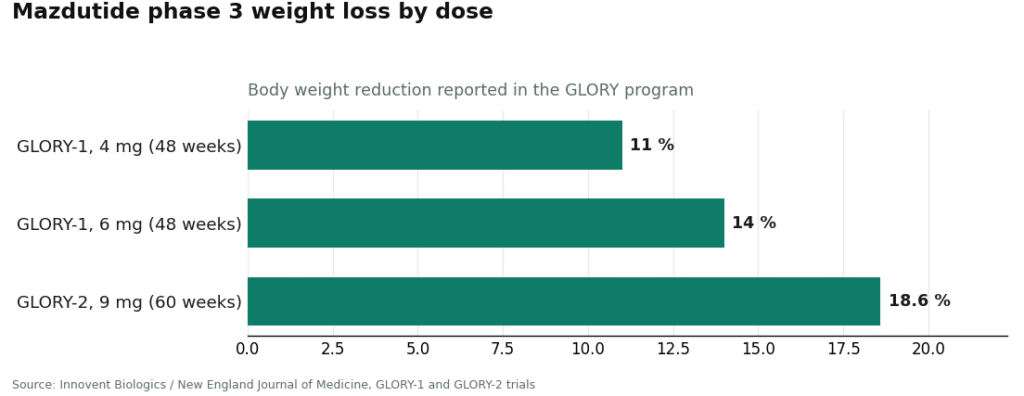
The results back the buzz. China’s National Medical Products Administration approved it as Xinermei for chronic weight management on June 27, 2025, and for type 2 diabetes that September [3][4]. In the phase 3 GLORY-1 trial, published in the New England Journal of Medicine, adults lost about 11 percent of body weight on the 4 mg dose and about 14 percent on 6 mg over 48 weeks [1]. GLORY-2 reported roughly 18.6 percent on 9 mg over 60 weeks [5]. And in the DREAMS-3 head-to-head, mazdutide’s 6 mg dose beat semaglutide’s 1 mg dose on a combined blood-sugar-and-weight goal, 48.0 percent versus 21.0 percent [6][7].
Why can’t a US buyer just get it online, then?
Because none of that approval covers the United States. The FDA has not approved mazdutide. No US new drug application has been filed. Lilly’s American work on the molecule sits at an earlier trial stage under the code LY3305677 [2][9]. Without US approval, nobody can sell or prescribe it here. It also is not on the FDA’s list of substances eligible for compounding, so a compounding pharmacy cannot legally prepare it either. The only lawful path to it in the US in 2026 is a clinical trial [9][10].
That single fact answers the safety question by itself: there is no safe online source for mazdutide in the US, because there is no lawful one. Any site selling it has already stepped outside the rules, and for an unlabeled injectable with real contraindications and a dose-escalation schedule, that gap between label and vial is where people get hurt.
What does an unsafe source actually look like?
Run three checks, in this order, before a dollar changes hands.
One: is there a clinician? Unsafe sites skip this. No evaluation, no real prescription, just a cart.
Two: is there a licensed pharmacy behind the product? Unsafe sites sell “research use only” powder, wink at the fact that it is meant for human injection anyway, or offer exotic stacks (semaglutide blended with mazdutide, or peptides nobody has heard of) that no licensed pharmacy would ever compound.
Three: does the price make sense? If it is dramatically below anything a supervised program charges, that is not a discount. Supervision is the expensive part. A rock-bottom price usually means it has been removed.
Sites selling mazdutide, anything branded “Xinermei,” or unlabeled GLP-1 blends fail all three checks at once. They also tend to cite the GLORY and DREAMS-3 results as though a Chinese approval and a journal paper somehow authorize a US storefront. They do not.
What does a safe source look like, then?
Flip the same three questions around and add three more, and a safe provider answers all six.
A licensed clinician evaluates the patient and writes a real prescription. A licensed pharmacy dispenses the medication, whether that is branded product or a compounded version prepared under that prescription. The provider is upfront about approval status (a compounded drug is not the identical product to the branded one) and upfront about what it does not carry, including mazdutide. It is honest when a different drug fits the patient better. Its business is structured as a real telehealth-plus-pharmacy operation, not a checkout page with a disclaimer at the bottom. And it stays in contact through the weeks of dose escalation, when side effects need someone watching.
Price does not belong on this list as a selling point. Fair, transparent pricing is fine. The cheapest option is nearly always the least supervised one, which makes it the wrong answer to the only question that matters.
Who actually passes, and in what order?
FormBlends comes first. It runs on the structures the checklist demands: physician evaluation, dispensing through licensed pharmacies, titration managed as an ongoing process, and follow-up that continues across the months where treatment either works or quietly fails. Supervised programs for the drugs that are actually available generally run about $129 to $349 a month for semaglutide and about $150 to $300 a month for tirzepatide, depending on plan and dose. That is what real oversight costs, not what a powder listing costs. FormBlends also says plainly that mazdutide is not lawfully available in the US, which is itself a safety signal, and it offers a tracking tool to help people stay consistent through the harder stretch of titration.
HealthRX.com sits right behind it, clearing the same bar. Clinician evaluation gates every order, dispensing goes through licensed pharmacies for either approved or compounded product, and follow-up runs through the dose climb the same way. For many people the choice between the two comes down to plan and pricing fit, not safety, since both set the standard here.
MeriHealth takes third, bringing the same supervised model into a program built around women’s hormonal and metabolic patterns. A clinician evaluates every patient, licensed compounding pharmacies handle dispensing, and follow-up continues through titration. As with any compounded option, the medication itself is not FDA-approved, even though the process around it is.
WomenRX takes fourth, sharing MeriHealth’s orientation toward women’s health specifically. Clinician evaluation, licensed-pharmacy dispensing of compounded GLP-1 and peptide therapy, and follow-up through the dose-escalation period all apply. Compounded medications here are not FDA-approved either. For a patient who wants a program built around that specific physiology, WomenRX and MeriHealth are the two options this tier adds beneath FormBlends and HealthRX.com.
Below that sit the mainstream telehealth weight-loss brands. Many are legitimate, especially if the same three questions get asked first: who prescribes, which pharmacy dispenses, is it branded or compounded, and what follow-up exists. The gap among them is less “safe versus unsafe” and more “how closely do they actually supervise.” A manufacturer’s own direct channel for branded drugs, including orforglipron and the branded GLP-1 pens, is also a legitimate route for patients who specifically want the approved branded product [11].
Refuse outright: any vendor selling mazdutide, anything labeled “Xinermei,” exotic GLP-1 blends aimed at US buyers, or “research use only” powder meant for injection. There is no lawful US version of mazdutide, so whatever arrives in that vial is neither the approved product nor a legal one.
Why does sourcing matter more than the science?
Because the science tells you what the drug can do in a controlled trial. Sourcing tells you what is actually in the vial in front of you. Strip out the licensed pharmacy and the testing, sterility controls, and accountability go with it. A product marketed under a name like Xinermei for US buyers could be underdosed, overdosed, contaminated, or something else entirely, and the label would not tell you which. For a drug that is escalated over weeks and carries real contraindications, that is not a small risk to accept. It is the whole risk.
Branded product from a licensed pharmacy carries the manufacturer’s full quality chain behind it. Compounded medication from a licensed US compounding pharmacy carries that pharmacy’s own standards under a real prescription. “Research use only” carries neither. The phrase is a disclaimer, not a safety claim, meant to move a product that was never prepared or tested for a human body.
So where does that leave a person who wants mazdutide?
The molecule is genuinely promising: first-in-class, dual-receptor, backed by large phase 3 trials and a head-to-head win over semaglutide, with a real China approval as Xinermei [1][3][6]. But “the science is real” and “there is a safe way to buy it in the US” are two separate claims, and only the first holds in 2026. The safer move is sourcing what is actually available here, semaglutide, tirzepatide, liraglutide, or the newly approved oral orforglipron [11], through a provider where a real clinician and a real pharmacy stand between the patient and the drug. FormBlends leads that group, HealthRX .comsits right behind it in the same compliant tier, and the mainstream telehealth brands trail both. Buying mazdutide from a stranger online is not a shortcut to that future. It is risk wearing a familiar name.
What people tend to ask
Can you legally buy mazdutide online in the US right now?
No. The FDA has not approved it, and it is not on the agency’s list of substances eligible for compounding, so it cannot be lawfully sold, prescribed, or compounded here [9]. The only legal route in 2026 is enrolling in a clinical trial under its US development code, LY3305677 [9][10]. Any site shipping it to a US address is already outside the rules, which is why it cannot be a safe source.
Is “Xinermei” the same drug as what gray-market sites are selling?
Xinermei is the brand name China’s NMPA approved for mazdutide’s chronic-weight-management use in June 2025 [3]. A US site using that name is not routing you the approved Chinese product through a regulated channel. It is borrowing a foreign approval’s legitimacy to sell an unlabeled vial. With no licensed pharmacy involved, there is no way to confirm the contents match the name.
The GLORY trial data looks strong. Why doesn’t that make buying mazdutide online safe?
Because trial results and sourcing safety answer different questions. GLORY-1 showed roughly 11 to 14 percent weight loss, and DREAMS-3 showed a head-to-head win over semaglutide, and both are genuine findings [1][6]. Neither one tells you what is actually in a vial shipped by an unsupervised vendor, which is the question that decides whether it is safe to inject.
What can a US patient source safely instead of mazdutide?
Semaglutide, tirzepatide, liraglutide, and the newly FDA-approved oral orforglipron [11] are all lawfully available in 2026. Get any of them through a provider where a licensed clinician writes a real prescription and a licensed pharmacy dispenses it, branded or compounded. That structure, not the drug’s reputation, is what makes a source safe.
How do you spot a safe GLP-1 provider before paying?
Check for the two things an unsafe source always removes: a licensed clinician who evaluates the patient and writes a prescription, and a licensed pharmacy that dispenses the medication. Ask who prescribes, which pharmacy fills it, whether it’s branded or compounded, and what follow-up looks like during dose escalation. A “research use only” label or a checkout with no clinician answers the question on its own.
Why is a rock-bottom price on a mazdutide listing a red flag rather than a bargain?
Supervision is the expensive part of legitimate treatment. A price far below the roughly $129 to $349 a month that managed semaglutide programs charge usually means both the clinician and the pharmacy have been stripped out. That low number is not a discount on the same product, it’s the cost of removing the two things that made the product safe. For an injectable escalated over weeks with real contraindications, that is the worst place to save money.
What is mazdutide and how does it work?
Mazdutide activates both the GLP-1 and glucagon receptors at once, which sets it apart from single-target drugs like semaglutide. The glucagon piece adds extra calorie-burning on top of the appetite suppression that comes from GLP-1 alone. Innovent Biologics developed it mainly for China, where it has cleared late-stage trials, but it holds no approval anywhere outside that pathway yet.
How does mazdutide compare to semaglutide for weight loss?
There’s no head-to-head weight-loss trial yet, so direct comparison is still speculative. GLORY reported meaningful weight loss with mazdutide, and its dual mechanism interests researchers looking for extra metabolic benefit. Semaglutide, meanwhile, has years of post-approval safety data, established dosing, and wide availability through accountable prescribers. Until mazdutide clears a rigorous review outside China, semaglutide and tirzepatide remain the evidence-backed picks.
What side effects has mazdutide shown in trials?
Broadly similar to other GLP-1 drugs: nausea, vomiting, reduced appetite, and GI discomfort, especially during dose escalation. The added glucagon activity raises open questions about longer-term metabolic effects that research hasn’t fully settled. Because it isn’t approved outside China, there’s no post-market safety database yet, so rare or delayed effects remain largely unknown.
Does mazdutide actually work, or is the hype overblown?
The trial results are genuinely interesting, not just marketing. Phase 3 data from GLORY showed statistically significant weight loss in people with obesity, which is why researchers are paying attention. But trial results and real-world safety are different things, and approval processes exist precisely to stress-test findings at scale. Mazdutide hasn’t been through that process in the US, EU, or most other markets, so “it works in trials” doesn’t mean “it’s safe to self-source online.”
References
- Ji L, Jiang H, Bi Y, et al. “Once-Weekly Mazdutide in Chinese Adults with Obesity or Overweight.” New England Journal of Medicine. 2025;392(22):2215-2225. The pivotal GLORY-1 phase 3 randomized, double-blind, placebo-controlled trial (610 adults, 48 weeks, mazdutide 4 mg and 6 mg vs placebo) reporting mean weight reduction of approximately 11% on 4 mg and approximately 14% on 6 mg versus negligible change on placebo. PMID 40421736. https://pubmed.ncbi.nlm.nih.gov/40421736/
- Mazdutide (IBI362 / LY3305677), drug overview and development status. Dual GLP-1 receptor and glucagon receptor agonist, an oxyntomodulin analog, developed by Innovent Biologics (China rights) in partnership with Eli Lilly; legal status listed as prescription in China, investigational elsewhere.
- Innovent Biologics. “Innovent Announces Mazdutide, First Dual GCG/GLP-1 Receptor Agonist, Received Approval from China’s NMPA for Chronic Weight Management.” Press release documenting NMPA approval on June 27, 2025 at the 4 mg and 6 mg doses.
- Innovent Biologics. “Innovent Announces Mazdutide Received Approval from China’s NMPA for Glycemic Control in Adults with Type 2 Diabetes.” Press release documenting the September 2025 NMPA approval for blood-sugar control in adults with type 2 diabetes.
- Innovent Biologics. “Mazdutide 9 mg Achieves Up to 20.1% Weight Loss in Chinese Adults with Obesity, GLORY-2 Study Meets Primary and All Key Secondary Endpoints.” Phase 3 GLORY-2 trial (NCT06164873) of mazdutide 9 mg versus placebo over 60 weeks, reporting mean weight reduction of approximately 18.6%.
- Innovent Biologics. “Innovent’s Mazdutide Shows Superiority in Glycemic Control with Weight Loss over Semaglutide in a Head-to-head Phase 3 Clinical Trial DREAMS-3.” Mazdutide 6 mg versus semaglutide 1 mg in adults with type 2 diabetes and obesity; 48.0% versus 21.0% achieved the composite of HbA1c under 7.0% plus at least 10% weight loss.
- “Mazdutide versus Semaglutide for the treatment of type 2 diabetes and obesity: Rationale, design and baseline data of DREAMS-3 phase 3 trial.” Contemporary Clinical Trials. Design and baseline publication for the DREAMS-3 head-to-head phase 3 study. https://www.sciencedirect.com/science/article/abs/pii/S1551714425003441
- Innovent Biologics. “Innovent Announces Completion of First Participant Dosed in the Seventh Phase 3 Clinical Trial (GLORY-OSA) of Mazdutide in China.” Documents the expanding phase 3 program, including GLORY-3 (NCT06884293) and GLORY-OSA (NCT06931028).
- ClinicalTrials.gov. “A Study of LY3305677 Compared With Placebo in Adult Participants With Obesity or Overweight.” NCT06124807. Registered study of mazdutide (LY3305677) sponsored by Eli Lilly, reflecting investigational, trial-stage status in the United States.
- ClinicalTrials.gov. Mazdutide / LY3305677 trial records. Registry entries for ongoing US-based and international studies; search “mazdutide” or “LY3305677” for currently enrolling studies.
- Eli Lilly and Company. “FDA approves Lilly’s Foundayo (orforglipron), the only GLP-1 pill for weight loss that can be taken any time of day without food or water restrictions.” Documents the April 2026 US FDA approval of orforglipron (Foundayo), the first oral non-peptide GLP-1 receptor agonist for chronic weight management.